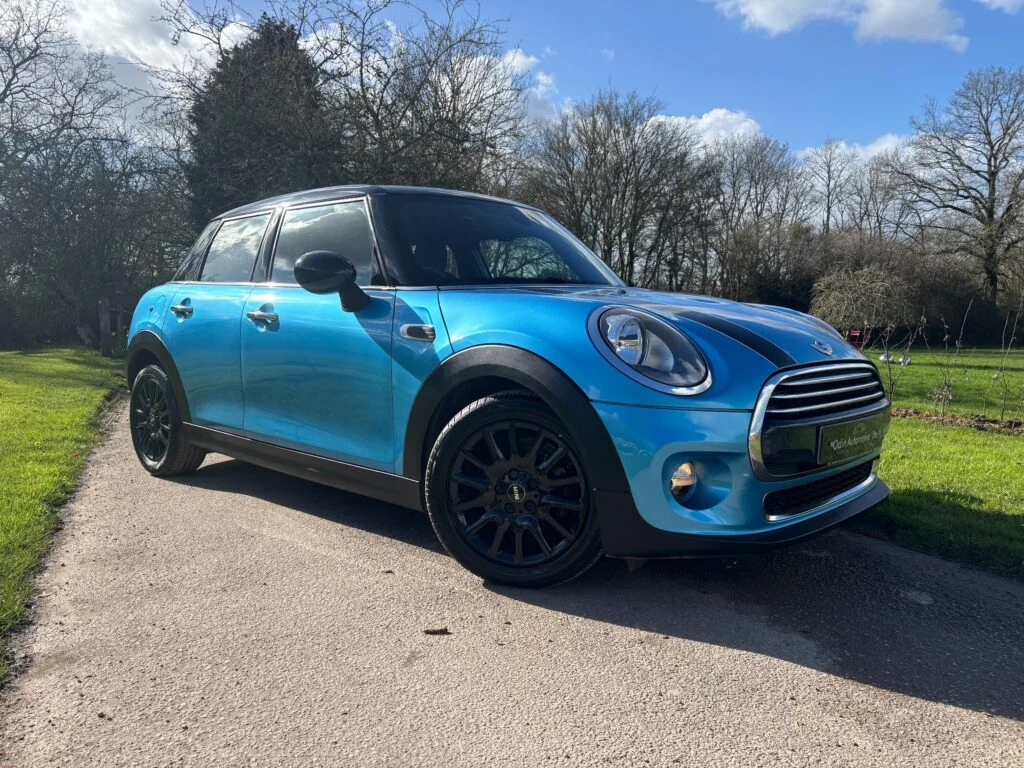
For most used buyers, petrol is the one to go for. A petrol MINI Cooper is cheaper to buy, easier to look after, and almost always ULEZ compliant. Diesel only starts to make sense if you regularly cover big motorway miles, roughly 15,000 to 20,000 a year, and even then you’ll want to check the timing chain and emissions kit carefully. If your driving is mostly town runs and short hops, go petrol.
That’s the answer. Here’s the reasoning, engine by engine, so you can match the fuel to how you actually drive.
Why the fuel choice matters more on a MINI
People buy a MINI to enjoy driving it, and the fuel type changes what that ownership feels like. Diesels bring strong economy and lazy mid-range pull, which suits long, steady journeys. Petrols are keener to rev and cheaper to fix when something goes wrong. Pick the wrong one and you’ll either be nursing a diesel that never warms up properly on short trips, or wishing you had more range on a long motorway slog.
The other reason it matters is money. The purchase price, the running costs and the repair bills all shift depending on which engine sits under the bonnet, so it’s worth taking them in turn.
Running costs: diesel wins on paper, petrol wins in town
On fuel alone, diesel looks like the obvious pick. The older Cooper D and SD are genuinely frugal, and Parkers describes the discontinued diesels as “very economical”, with real-world figures often in the low-to-mid 60s mpg. Modern petrol MINIs have closed the gap more than people expect, though. Parkers lists the petrol Cooper at up to 51.4mpg and the Cooper S at a claimed 48.7mpg on the WLTP cycle. That’s not far off a diesel once you factor in the extra cost of diesel fuel at the pump.
Here’s where it turns. Diesels want long, warm runs to stay healthy. Short town journeys never let the diesel particulate filter, the DPF, get hot enough to clean itself, and a clogged DPF is a bill you don’t want. So the paper economy only lands if you’re actually doing the miles. As a rough guide, you need to be covering something like 15,000 to 20,000 miles a year before the diesel’s fuel saving pays back the higher buy-in and the extra maintenance risk.
Road tax sits close either way on the newer cars. Parkers puts the MINI range at £20 to £265 a year depending on the exact model and its emissions.
The engines, and the faults that come with them
This is the part that decides most sensible purchases. Buy the car, yes, but really you’re buying the engine and its history. Use the V5C and the reg to work out exactly what you’re looking at; our guide on how to identify your MINI’s model and generation walks you through it.
Diesel engines
Pre-2010 Cooper D cars use a PSA-derived 1.6 diesel, the same family found in various Peugeot and Citroën models. It has a solid reputation, and its DPF is an element type that’s cheap to swap, often around £120.
From 2010 the MINI moved to BMW’s own N47 diesel. This is the one to watch. The N47 has a well-documented timing chain problem: the chain sits at the back of the engine, and when it stretches or the tensioner fails it can rattle, usually worst on a cold start. Left alone it can wreck the engine. Because the chain is at the back, replacement means pulling the engine, and a full job can run to around £2,400. A new DPF on the N47 is nearer £800 than £120, too. None of this rules the car out, but you must hear it start from cold and see paperwork for any chain work.
Petrol engines
The petrol side isn’t fault-free either. The second-generation Cooper S with the N14 engine (2007 to 2010) is prone to carbon build-up on the intake valves, a side effect of direct injection and the crankcase breather design. The fix is walnut blasting, typically needed every 40,000 to 60,000 miles. The later N18 improved things but can still carbon up. On the plain Cooper, the naturally aspirated engines are simpler and generally cheaper to keep going.
The pattern across the range is clear enough: petrol repairs tend to be more frequent but smaller, diesel repairs rarer but far more expensive when they land. If you want the fuller picture on ownership bills, we’ve broken down what a MINI actually costs to maintain separately.
ULEZ and city driving: a big one for older diesels
If you drive in London or any Clean Air Zone, this can settle the argument on its own. To avoid the daily charge, a petrol car needs to meet Euro 4 and a diesel needs to meet Euro 6. Per the RAC’s ULEZ guidance, almost every petrol registered from January 2006 is compliant, but diesels generally need to be from around September 2015 onwards.
That’s the catch with a cheap used diesel MINI. A tidy 2012 Cooper D might look like a bargain until you realise it isn’t ULEZ compliant and costs you £12.50 every day you drive it into London, or £8 a day in Birmingham. An equivalent-age petrol almost certainly is compliant. For city buyers on a budget, that single fact usually points straight at petrol.
So which should you buy?
Match the car to your mileage and where you drive:
Buy petrol if you do average mileage, lots of short or town trips, or you drive in a Clean Air Zone. It’s cheaper to buy and the faults, when they come, are the more affordable kind. This covers most people.
Buy diesel if you genuinely rack up long motorway miles every year and want the range and economy, and you’re prepared to check the timing chain (on N47 cars) and buy a Euro 6 example if you go near a low-emission zone. Buy the best-maintained diesel you can find, not the cheapest.
Whichever way you lean, get any car you’re serious about checked before money changes hands. A pre-purchase inspection is cheap next to a timing chain or a DPF, so it’s worth booking a mechanic to look it over first.
FAQs
Is a petrol or diesel MINI Cooper cheaper to run?
It depends on your mileage. Diesel wins on fuel economy for high-mileage motorway drivers, often in the low-60s mpg on older Cooper D and SD models. For average or town mileage, petrol usually works out cheaper overall once you account for pricier diesel fuel, DPF risk, and the higher cost of diesel repairs.
Are diesel MINIs reliable?
The pre-2010 PSA 1.6 diesel has a good reputation. The later BMW N47 diesel is capable but carries a known timing chain risk that’s expensive to fix, so buy one with a clear service history and listen for rattles on a cold start. For a wider view, see our take on whether MINIs are reliable.
Which used MINI diesels are ULEZ compliant?
Broadly, diesel MINIs registered from around September 2015 meet Euro 6 and are ULEZ compliant. Many older Cooper D models are not, which means a £12.50 daily charge in London. Always check the specific car on Transport for London’s checker before you buy.
Does MINI still make a diesel Cooper?
No. New MINI Hatch models are petrol or fully electric; the diesels are all used-market cars now. If you want a diesel MINI, you’re shopping second-hand.
How many miles do you need to do for a diesel to be worth it?
As a rule of thumb, around 15,000 to 20,000 miles a year. Below that, the fuel saving rarely covers the higher purchase price and the extra maintenance risk, and short journeys can cause DPF problems.
Ready to find yours?
Once you know whether petrol or diesel suits your driving, the next step is finding a well-kept example. Browse the used MINI Cooper listings on Mini Trader, a marketplace built only for MINIs, with no seller transaction fees and a community that knows these cars inside out.
There isn't a hard cut-off. A used MINI with a full service history and clean paperwork will usually be a safer buy at 110,000 miles than a neglected one a
For most used buyers, a manual MINI Cooper is the safer and more involving choice, and the Getrag manuals fitted since 2004 have been some of the toughest
Top Ratings & Reviews! MINI Trader is your premier destination for buying and selling MINI cars, parts and accessories. Our mission is to connect buyers and sellers in a trusted and user-friendly marketplace tailored specifically to the MINI community.